From Protected Supply to Competitive Abundance
Olusegun Famakin FOA Publishers | 2026
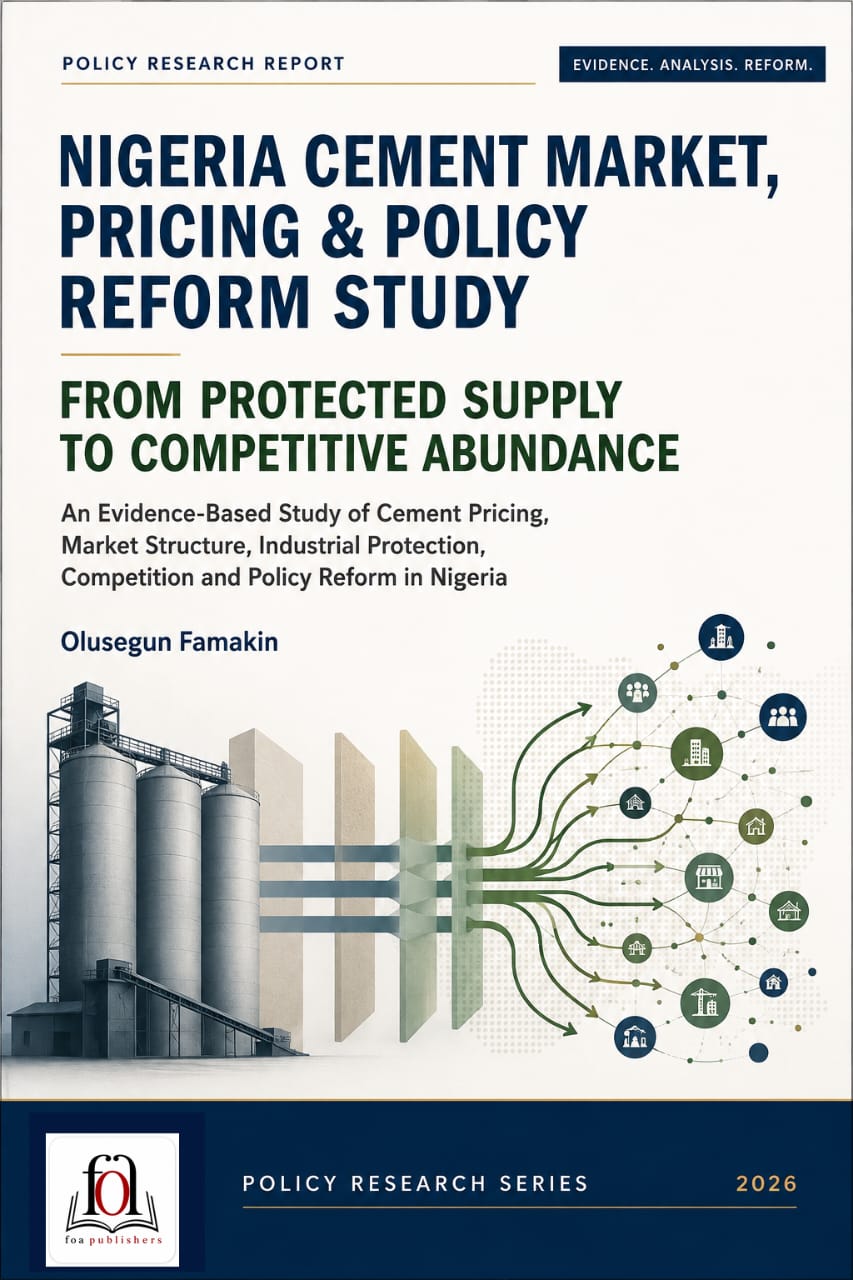
Web Edition
This Web Edition presents the Nigeria Cement Market, Pricing & Policy Reform Study: From Protected Supply to Competitive Abundance, an independent evidence-based examination of cement pricing, market structure, industrial protection, competition and policy reform in Nigeria.
The study examines the relationship between Nigeria’s substantial installed cement-production capacity and actual production, capacity utilisation, market concentration, barriers to entry, production and distribution costs, trade and industrial policy, competition, affordability and the effectiveness of existing policy responses.
Its central policy question is not whether Nigeria has succeeded in establishing a domestic cement industry. It has. The question is whether the present market and policy architecture is now capable of translating that industrial capacity into competitively priced cement, stronger market discipline and wider economic benefit.
The Web Edition is provided to widen access to the study and support professional, industry, regulatory and public-policy discussion. Readers are invited to examine the evidence, methodology, supporting analyses and policy recommendations presented in the study.
The complete publication, including the supporting research annexures and reference material, is also available as a downloadable PDF.
Executive Summary
Nigeria has already demonstrated that it can build a large cement industry. The next policy challenge is to demonstrate that this industrial success can deliver competitively priced cement to Nigerians.
Over the past two decades, Nigeria has moved from substantial dependence on imported cement towards significant domestic installed production capacity. This represents an important industrial-policy achievement. Domestic limestone resources, large-scale private investment, import-substitution policies and sustained demand from housing and infrastructure have helped establish Nigeria as one of Africa’s major cement-producing economies.
Yet the expansion of installed capacity has not translated proportionately into abundant and competitively priced cement for the domestic consumer. Cement prices have continued to rise, construction costs have increased, housing affordability has deteriorated, and government infrastructure expenditure has become more expensive. The central policy problem examined in this study is therefore not simply whether Nigeria possesses sufficient installed cement capacity, but whether the structure and operation of the market allow that capacity to translate efficiently into production, competition, supply and affordable prices.
The Central Finding
The study finds that Nigeria’s cement challenge cannot adequately be explained by any single factor such as energy prices, exchange-rate depreciation, transportation costs or general inflation. These pressures are real and materially affect production costs, but they operate within a highly concentrated market protected by significant barriers to external and domestic competitive entry.
The distinction between installed capacity and actual production is therefore critical. Installed capacity represents what the industry could theoretically produce under appropriate operating conditions; actual output determines the volume of cement available to the market. Persistent unused capacity, when combined with high market concentration and restricted competitive entry, weakens the assumption that nominal capacity alone guarantees effective supply competition.
The evidence consequently points towards a structural policy problem: Nigeria has achieved substantial domestic productive capacity without yet achieving the degree of competitive abundance that should ordinarily accompany such industrial scale.
Market Concentration and Competition
The Price Paradox
Nigeria possesses extensive limestone resources, significant installed cement-production capacity and a domestic clinker base capable of supporting cement production both for the Nigerian market and for regional trade. Yet Nigerian consumers continue to face high and rising cement prices.
This creates a fundamental policy paradox. A country that successfully pursued import substitution to reduce dependence on foreign cement should ultimately expect domestic industrial maturity to produce stronger supply security, increasing competition and progressively greater consumer benefit.
Where domestic clinker and cement originating from Nigeria can participate competitively in regional markets while domestic consumers continue to experience severe price pressure, the issue deserves examination beyond the conventional explanation of production cost alone.
The “Ghost Subsidy” Problem
This study describes an important consequence of prolonged industrial protection as a “ghost subsidy”.
The term is used to describe the economic value transferred to a protected domestic industry through restrictions that reduce or eliminate competitive alternatives, even where government makes no direct fiscal payment to producers.
Import restrictions, licensing barriers and other protective measures can be legitimate instruments of infant-industry development. Their economic justification, however, depends upon the protected industry eventually becoming sufficiently mature, productive and competitive to deliver benefits to the wider economy.
Where protection continues after industrial maturity while domestic prices remain persistently elevated, consumers may effectively bear part of the cost of protection through reduced competitive choice and higher prices. The subsidy is therefore not visible as a budgetary expenditure, but its economic effect may nevertheless be real.
Barriers to Entry
The study finds that the effectiveness of competition in the Nigerian cement market is influenced not only by the number of existing producers but also by the ability of new suppliers to enter and contest the market.
Cement manufacturing is naturally capital intensive. New entrants require access to suitable limestone deposits, mining rights, environmental approvals, substantial plant financing, reliable energy, transportation infrastructure, distribution networks and sufficient market scale. These constitute legitimate economic and technical barriers to entry.
Policy-created barriers can compound these natural barriers. Restrictions on cement imports, regulatory complexity, access to mineral resources, infrastructure constraints and the scale advantages enjoyed by established integrated producers can significantly reduce the competitive threat posed by potential entrants.
Nigeria’s continuing expansion of road, housing and infrastructure programmes should ordinarily strengthen the investment case for additional production and supply capacity. In a sufficiently contestable market, sustained demand and elevated prices should themselves provide signals capable of attracting new investment.
The limited competitive response therefore deserves policy attention. The relevant question is not whether established producers should be weakened, but whether the market architecture provides sufficient opportunity for efficient new domestic producers, regional suppliers and other credible competitors to challenge existing market positions.
Why Administrative Price Intervention Is Not Enough
Successive periods of cement-price escalation have produced calls for government intervention, meetings with manufacturers, negotiated price reductions and other forms of administrative price management.
Such interventions may provide temporary political or consumer relief, but they do not resolve the structural conditions determining market prices.
A negotiated price can be announced without changing industry concentration, capacity utilisation, barriers to entry, logistics costs, energy costs, distribution margins or the competitive alternatives available to buyers. Where these underlying conditions remain unchanged, administrative price agreements are unlikely to provide a durable solution.
The repeated re-emergence of the cement-price problem therefore demonstrates the limitations of treating price itself as the primary policy variable.
Sustainable price discipline is more likely to arise from production efficiency, higher capacity utilisation, transparent market information, contestable supply, efficient logistics and credible competitive pressure than from periodic government-manufacturer price negotiations.
From Industrial Protection to Competitive Maturity
The study does not argue that Nigeria’s historic cement-industry protection was inherently misguided. Import substitution contributed materially to the establishment of substantial domestic manufacturing capacity and reduced the country’s former dependence on imported finished cement.
The relevant policy question is whether instruments designed to establish an infant industry remain appropriate after that industry has achieved substantial scale and maturity.
Industrial policy should evolve with industrial development.
Protection may be justified during the establishment of strategic domestic capacity. Once substantial capacity, technical capability, domestic clinker production and established producers exist, policy emphasis should progressively shift towards productivity, capacity utilisation, investment, competition, export capability and consumer welfare.
The objective should therefore not be a return to indiscriminate import dependence. It should be the transition from protected domestic supply towards competitive domestic abundance.
Capacity Utilisation as a Policy Indicator
Installed capacity should no longer be treated as sufficient evidence of market adequacy.
Policy monitoring should distinguish clearly between installed capacity, operational capacity, actual clinker production, actual cement production, domestic dispatch, exports and effective capacity utilisation.
A market may possess substantial nominal capacity while still experiencing constrained effective supply. Transparent reporting of these indicators would therefore materially improve regulatory analysis and public understanding of the industry.
Capacity utilisation should become one of the principal indicators used in evaluating whether existing industrial protection continues to produce proportionate public benefit.
Raw Materials and Production Transparency
Nigeria’s substantial limestone endowment is a strategic industrial advantage. The governance of these mineral resources should support both industrial development and transparent assessment of the cement value chain.
Improved reporting of limestone extraction, mineral titles, production volumes, clinker output and related industrial utilisation would strengthen the evidence available to policymakers, regulators, investors and researchers.
Relevant reporting obligations under Nigeria’s solid-minerals regulatory framework should therefore be applied in a manner that enables government to understand more clearly the relationship between mineral extraction, installed industrial capacity, actual production and market supply.
Better information will not determine prices by itself, but effective competition policy cannot operate successfully where essential market information remains fragmented or inaccessible.
Principal Policy Direction
The principal recommendations of the study are:
The principal recommendations of the study are:
- Establish a transparent national cement-market monitoring framework covering installed capacity, operational capacity, actual production, capacity utilisation, domestic dispatch, exports and indicative regional price movements.
- Strengthen competition oversight of the cement market, with particular attention to market concentration, barriers to entry, distribution structures and conduct capable of weakening effective competition.
- Review the continuing scope and design of cement-import restrictions as the domestic industry transitions from infant-industry protection to industrial maturity.
- Develop a calibrated competitive-import mechanism that can be activated under clearly defined market conditions rather than relying upon unrestricted imports or permanent prohibition.
- Replace episodic administrative price negotiations with structural measures directed at competition, production, supply, logistics and market transparency.
- Improve access to limestone resources and the transparency of mineral-title and production reporting in order to facilitate credible new investment and strengthen accountability for strategic mineral utilisation.
- Encourage higher utilisation of existing productive capacity while identifying technical, commercial, energy, logistics or market constraints responsible for persistent unused capacity.
- Reduce infrastructure and logistics bottlenecks affecting the movement of limestone, clinker and finished cement.
- Maintain appropriate product-quality, standards, customs and anti-dumping safeguards within any future trade-liberalisation framework.
- Subject major cement-policy interventions to periodic evidence-based review so that protective measures do not continue indefinitely after their original industrial-development justification has substantially changed.
The Policy Choice
Nigeria does not face a binary choice between protecting domestic cement manufacturers and abandoning them to unrestricted foreign competition.
A more credible policy path lies between these extremes.
The country can preserve the industrial capacity it has successfully built while progressively exposing that capacity to stronger incentives for efficiency, utilisation, investment and competition. It can protect against dumping without protecting inefficiency. It can support domestic manufacturing without insulating the market permanently from competitive discipline.
The transition required is therefore not from domestic production to import dependence, but from protected supply to competitive abundance.
Nigeria has already demonstrated that it can build a large cement industry. The next policy challenge is to demonstrate that this industrial success can deliver competitively priced cement to Nigerians.
Read the Complete Study Online
The complete Nigeria Cement Market, Pricing & Policy Reform Study is available below as an interactive Web Edition. Readers may scroll through the publication or use the module guide below to navigate the study.
REPORT NAVIGATOR
Front Matter
Purpose and Policy Relevance
Preface
Research Approach
Executive Summary
Table of Contents
List of Annexures
MODULE I — THE POLICY QUESTION
Chapter 1 — Nigeria’s Cement Price Paradox
Chapter 2 — Purpose, Objectives and Research Questions
MODULE II — RESEARCH DESIGN & RESOURCE BASE
Chapter 3 — Research Methodology and Evidence Architecture
Chapter 4 — Raw Materials, Production and Industrial Structure
MODULE III — MARKET POWER, ENTRY & PRICE FORMATION
Chapter 5 — Market Concentration, Competition and Entry Barriers
Chapter 6 — Cost Structure, Capacity Utilisation and Price Formation
MODULE IV — SHOCKS, PASS-THROUGH & RESIDUAL PRICE
Chapter 7 — Macroeconomic Shocks and Cement Price Transmission
Chapter 8 — AGO-Weighted Pass-Through and Residual Price Analysis
MODULE V — INTERNATIONAL PARITY, TRADE PROTECTION & THE GHOST SUBSIDY
Chapter 9 — Nigeria in the International Cement Market
Chapter 10 — Import Restrictions, the Ghost Subsidy and the Cost of Protection
MODULE VI — REVEALED TRADE, COUNTERFACTUALS & THE AFFORDABLE PRICE CORRIDOR
Chapter 11 — The Nigeria–Togo Revealed-Trade Case
Chapter 12 — Counterfactual Policy Scenarios
Chapter 13 — Can Nigeria Sustain ₦100–₦130 per Kilogram?
MODULE VII — CEMENT MARKET REFORM & AUTOMATIC COMPETITIVE SAFEGUARDS
Chapter 14 — Cement Market Reform Programme
Chapter 15 — Automatic Competitive Safeguard Framework
MODULE VIII — ECONOMIC DIVIDEND, INDUSTRIAL TRANSITION & RISK
Chapter 16 — Housing, Infrastructure and Fiscal Dividend
Chapter 17 — Industrial Impact, Transition Risks and Safeguards for Nigerian Manufacturing
MODULE IX — IMPLEMENTATION ROADMAP & CONCLUSION
Chapter 18 — Implementation Roadmap
Chapter 19 — From Protected Supply to Competitive Abundance
TECHNICAL ANNEXURES
H1 — Raw-Material Costs and Cement Price Formation
H2 — Logistics and Distribution Cost Hypothesis
H3 — Energy Cost and Cement Price Formation
H4 — Process Efficiency, Energy Intensity and Cost Sensitivity Analysis
H5 — Import Contestability, Border Protection and Cement Price Formation
H6 — Domestic Competitive Discipline, Shock Pass-Through and Price Persistence
H7 — Integrated Price Formation, Pass-Through and Residual-Causation Test
H8 — H1–H7 Convergence & Residual-Causation Analysis
GSE-1 — Ghost Subsidy Estimation, Economic Dispersion and Net-Benefit Methodology
Loading Viewer…
SHARE THIS STUDY
Know someone who may benefit from this policy study? Share the free online edition.
Share on WhatsApp Share on Facebook Share on XDOWNLOAD THE COMPLETE PUBLICATION
Prefer to read offline or retain a copy for reference?
The complete Nigeria Cement Market, Pricing & Policy Reform Study — including all chapters, supporting research annexures, statistical analyses and reference material — is available as a downloadable publication.
Published by FOA Publishers
Policy Research Series | 2026
HOW TO CITE THIS STUDY
HOW TO CITE THIS STUDY
Famakin, O. (2026). Nigeria Cement Market, Pricing & Policy Reform Study: From Protected Supply to Competitive Abundance. FOA Publishers, Policy Research Series 2026.
PUBLISHER
FOA Publishers
Independent Research, Knowledge & Practical Publications
Website: foapublishers.com.ng
Email: info@foapublishers.com.ng
© 2026 FOA Publishers. All rights reserved.